
Two Strangers, One Fate
The Intertwined Lives of George S. Stewart and Edward E. Hooper
Season Two of Company D is sponsored in part by:


Ep15: George S. Stewart and Edward E. Hooper
Show Transcript
It was a bargain they would both come to regret. Altering both their lives in ways neither could imagine at the time. It was struck on a sweltering late-August day, shortly before the men from Paris, Maine, who drafted to fight in the American Civil War, were scheduled to report for duty in Lewiston on September 1, 1863.
On that same day, a Grand Union Meeting was scheduled at Union Grove, between South Paris and Norway Village. Music would be played. Speakers would include Paris native Hannibal Hamlin, U.S. Vice President, and U.S. Army General Oliver O. Howard.
They would discuss the war, the upcoming election, and praise new draftees.
But on this day, there would be no music. No grand talks. No speeches. No crowds. Just a draft broker, a couple of clerks, and plenty of paperwork.
There was also the matter of paying George S. Stewart, a farmer from New Hampshire, a large sum of money.
The bargain was being struck between Stewart and Paris native, James E. Hooper. Neither Stewart nor Hooper knew each other and, in fact, they may never have met in person. But they were signing a contract together.
Binding their lives.
One month earlier, Hooper had been drafted into the military. Reluctant to serve, he hired a draft broker to find someone willing to take his place. A substitute.
That man was George S. Stewart.
Hiring a substitute wasn’t uncommon. Somewhere between 50,000 and 100,000 substitutes served in the American Civil War, with thousands of them from Maine. Contracts were signed. Money exchanged hands. It was a normal business arrangement.
At least that’s what they thought.
But on this hot summer day in Maine, neither Stewart nor Hooper could have known that their business arrangement would set off a strange chain of events that would forever intertwine their lives.
That despite Hooper paying Stewart several hundred dollars to take his place on the battlefield, the war would come for both of them anyway.
INTRODUCTION

Hello, and welcome to another episode of Company D, the narrative history podcast about the everyday soldiers serving in the American Civil War. Company D focuses on the men of Company D of the Third Maine Infantry
Regiment, a unit often overlooked in popular memory, despite being one of the Army of the Potomac’s most consistently engaged regiments.
While the stories we tell on Company D revolve around the periods before, during, and after the Civil War, they are personal histories of real soldiers and their families.
They are stories of their lives, relationships, and struggles. We look deeply at their whole lives and how they were affected by one of the most seismic events in U.S. history: the Civil War. This is microhistory at its best—at least we hope so.
Why this company and regiment? For us, it’s personal. My great-great-grandfather, Charles F. Snell, served with Company D of the Third Maine and left behind a diary of his wartime experiences—a diary that inspired this podcast.
I’m your host, George F. Snell III. Good things come in threes.
Two strangers. One bargain. This is the story of George S. Stewart and James E. Hooper.
They made a deal. Although at the time, neither of them realized the deadly consequences that would follow.
If they ever met, it was probably once and very briefly, signing papers to formalize an agreement. Yet it’s also possible that their entire business transaction was handled by their brokers, and they never met in real life.
Their transaction was not uncommon. Hooper had been drafted under the Enrollment Act of 1863 and did not want to serve in the military. He hired Stewart to serve as his substitute.
A draft broker would have made the arrangements, but the price was high, usually between $300 and $500, and possibly as much as $800. A fortune at the time ($500 is the equivalent of about $14,000 today). Hooper paid and got to stay home. Stewart took the money and went to war.
Stewart would vanish on the battlefield in 1864. He had deserted once before, and no one was sure what had happened to him. Did he run away again? Years later, the truth would prove far darker.
But Stewart’s disappearance may have added to the guilt that Hooper may already have been feeling about avoiding the war. Nine months after Stewart vanished, Hooper volunteered and joined the Twelfth Maine Infantry Regiment.
A decision he would come to regret.
Today on Company D, we explore how the lives of two strangers become so entangled that it leads to tragedy.
For both of them.
All aboard.

CHAPTER ONE: THE MYSTERY OF GEORGE S. STEWART
George S. Stewart has done a good job of avoiding history. He claimed to have been born in Holderness, New Hampshire, in 1837. At least, that’s what he informed the minister who would marry him years later, but there are no records of his birth there.
It’s possible he was born elsewhere, even in Canada or Ireland. He may have been an orphan. He first appears in the U.S. Census in 1860, living in Plymouth, New Hampshire, with his wife, Belinda, and two-year-old son, George. His occupation is brickmaker.
His wife, Belinda Curtis, married him on January 15, 1857, in Bridgewater, New Hampshire. They were joined in matrimony by Reverend Daniel Batchelder, but the marriage was never officially recorded.
George’s wife is almost as elusive as he is. Belinda Curtis was born on January 28, 1840, in Portland, Maine. She was the only child of Robert Curtis, a farmer from Bangor, and his wife, Hulda Collins. Her father moved his family to Boston around 1850 to work as a laborer.
Belinda’s parents appear to have separated when she was about twelve. She ended up living with neither of them. Where she went remains a mystery. By the time she married 20-year-old George S. Stewart in Bridgewater, she was 16 and using the name Belinda Jay.
After they married, George and Belinda settled in Bridgewater. Their son, George C., was born in 1859. They moved to nearby Plymouth, and George found work at a brick yard; there were at least two of them in Plymouth, one at Loon Pond and a second along the Baker River.
Brickmaking was physically demanding work. It involved hauling soil and clay, mixing the materials with water, pouring them into molds to dry, and then firing them in wood- or coal-fired kilns. A second son, Percy, was born in 1860.
By 1861, Stewart had left brickmaking and was trying his hand at subsistence farming on rented land. When the Civil War started in the spring of 1861, Stewart volunteered for a three-month stint with the New Hampshire state militia. He was sworn in as a private. His enlistment papers describe him as standing five feet four inches tall with blue eyes, brown hair, and a fair complexion. But he never officially mustered into service.
He was discharged honorably several weeks later, but no reason was given. He might have quietly requested the discharge as the sole provider for a young wife and two boys, both under four. His young family had no means of support, and without him working the land, Belinda and his sons would struggle to make ends meet.
Two years into the Civil War, the federal government passed the Enrollment Act of 1863, establishing a military draft. Stewart registered in New Hampshire. Maybe he feared he would be drafted anyway, or that his family needed the money, but at some point he contacted a draft broker and agreed to serve as a substitute for a draftee seeking to avoid service.
He would step in for them. For a price.

CHAPTER TWO: THE DRAFT
The draft for the Second District of Maine was held in Lewiston on July 15, 1863, in Central Small Hall on Main Street. A crowd of more than 150 people filled the space as city and state officials sat behind a long table at the front of the room.
The main feature was a hollow wooden cylinder about two feet in diameter, equipped with a crank and a trapdoor that opened into the drum. The names of registered men were written on slips of pasteboard, each measuring one inch by four inches, sealed inside an envelope, and placed within the drum.
The wheel was spun to mix the envelopes, then a blindfolded official opened the trapdoor and withdrew a ticket. The envelope was torn open, the card displayed for the audience, and the name read aloud. They went town by town, starting at 9:30 a.m. and continuing until they had called out the quota for the Second District: 1,765 men out of a field of more than 9,000.
The Second District draft occurred as reports of draft riots in Boston and New York City appeared in local newspapers, along with updated casualty lists for Maine regiments that fought at Gettysburg. Few people were happy with forced conscription.
Eventually, they reached the draft list for Paris, Maine, which had a quota of 73 men. The 36th name pulled from the drum belonged to James E. Hooper, a 25-year-old brakeman for the railroad. The 65th name called was his younger brother, George Jr.
The Hooper brothers were the sons of George P. Hooper, a prosperous farmer and loyal Democrat in Paris. The Hoopers were not adamantly opposed to the war like some of the more conservative Democrats, but no one in the family had volunteered to fight. George P. Hooper was the nephew and heir of Reverend James Hooper, known as Elder Hooper, the first Baptist minister in Paris and, before his death in 1842, among the town’s most influential men.
Two weeks after both his sons were conscripted, George P. Hooper stood up at a Paris town meeting about the town’s responsibility in raising its quota of volunteers and recruits for the U.S. Army. When the topic turned to how much to pay the new recruits, George argued for fiscal restraint.
George thought it unwise for the town to go into debt or raise any money until they were certain of the final quota number. He also urged the state to pay the bounties, not the individual towns. His call for fiscal restraint was dismissed, money for bounties was approved, and the meeting ended with three long cheers for the Union.
One wonders if George participated in the cheers. He must have known at this point that neither of his drafted sons would be marching off to war.
Both of them were hiring substitutes, likely with his financial support.

CHAPTER THREE: THE HOOPERS AVOID THE WAR
James E. Hooper was 25 years old when he was drafted. He worked as a brakeman for the railroad, a vital yet highly dangerous job that involved manually stopping trains and coupling rail cars. Statistically, being a brakeman was the most dangerous job in the United States, often requiring running along the roofs of moving boxcars and jumping between them to tighten hand-operated brake wheels on individual cars—sometimes at night and even when it was raining or snowing.
Injuries and death were not uncommon.
James married Maria Louise Maxim on January 5, 1859, when she was 18 and already five months pregnant. Maria was the oldest of 10 children born to Benjamin Maxim, a farmer from Buckfield and a former militia captain, and his wife Susannah Harlow.
When James’s name was called at the draft, he and Maria had two sons and a daughter, all under the age of four. Their family was growing fast.
We don’t know why James and his younger brother, George Jr., decided to hire substitutes rather than serve. Despite Paris, Maine, being the hometown of Republican Vice President Hannibal Hamlin, there was a sizable number of Democrats in and around Paris. The town’s largest newspaper was The Oxford Democrat, founded in 1834 as a mouthpiece for the Democratic Party.
Democrats at the time strongly favored States’ Rights, advocating policies that strengthened state autonomy and weakened the federal government. They opposed federal restrictions on slavery, particularly in the territories, but also on banning slavery in the South. They positioned themselves as the party of independent citizens symbolized by farmers and workers.
When the South seceded and the Civil War started, Democrats split into War Democrats and Peace Democrats. Many Northerners became the War Democrats. They were pro-Union and saw the Southern Rebellion as illegal and dangerous, but were often wary of abolition and, especially early in the war, hoped for a negotiated restoration of the Union.
The Peace Democrats, known as the Copperheads, saw the war as unnecessary and believed the South should be allowed to leave peacefully. The Copperheads were in the minority, but after the war started poorly for the United States, their numbers grew.
In Paris, right after the war started, The Oxford Democrat stood by Abraham Lincoln and his call for volunteers. “Stand by your country,” the newspaper declared. “Now is the time for men to show their patriotism.”
But James Hooper and his family weren’t convinced. While the Hoopers were likely Unionists, they seemed unenthusiastic about the war. This might be one reason James and none of his military-age brothers volunteered in 1861 and, later, when drafted in 1863, paid for substitutes rather than serve.
But there were likely other considerations for James—given that he was a new father with three young children when the war started, and that when he was drafted two years later, his wife was pregnant with their fourth child.
But at some point in early 1865, James E. Hooper had a change of heart. His reasons for changing his mind aren’t known either, but it may have had something to do with his wife’s brother, who had volunteered.
Or with the mysterious battlefield disappearance of the man he paid to take his place, George S. Stewart.
CHAPTER FOUR: RUN AS FAST AS YOU CAN
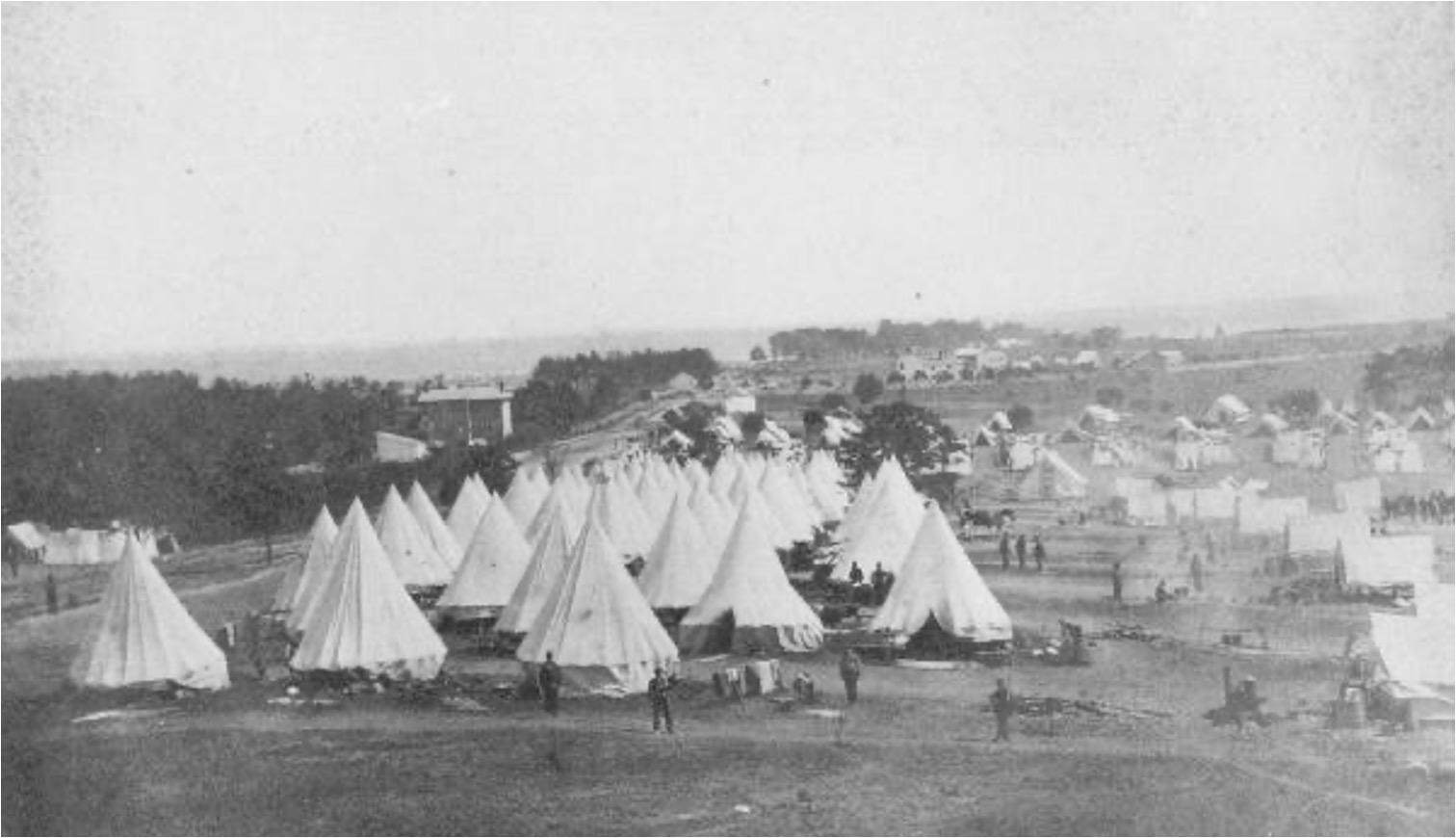
After George S. Stewart was processed into the U.S. Army, he was assigned as a private to Company D of the Third Maine Infantry Regiment. He arrived with the first batch of new recruits while the Third Maine was stationed in Topsham Springs, Virginia, on September 1, 1863.
Stewart was among a group of recruits that included brothers Benjamin and John Shorey, their friend Henry Huntress, and 15-year-old Granville Holt, who had claimed to be 18 when he enlisted.
Company D was in a confusing time. Captain Alfred S. Merrill remained in charge, but his second in command, First Lieutenant Woodbury Hall, was placed in charge of another company, and Second Lieutenant William H. Higgins, who had been hospitalized with a gunshot wound, was transferred to detached duty at Fort Mifflin in Philadelphia.
New men were coming in, others were transferred, and still others were getting sick and being hospitalized as the cold weather moved in. It wasn’t difficult to be overlooked or get lost in the confusion.
During the first two weeks, one of the new recruits, a 19-year-old Irish-born substitute named James Dorr, deserted while the regiment was on a march. He fled back to his family in Worcester, Massachusetts, and evaded authorities for the duration of the war.
Desertion was a serious offense and punishable by death. Stewart and the new Third Maine recruits had witnessed the execution of a deserter shortly before joining the regiment.
Yet a month after James Dorr ran, another Irish immigrant and substitute, James Welsh, also deserted. Welsh was 25 years old, avoided capture, and eventually ended up living in Wisconsin.
Shortly before Christmas, on December 23, it was Stewart’s turn. He deserted, yet another example of a substitute taking off. We don’t know where Stewart went, but he may have headed home to his wife and children back in New Hampshire. All we know for sure is that he was listed as deserting.
But the news that trickled back to Paris, Maine, in the winter of 1864, was that James E. Hooper’s substitute, the man he had paid a fortune to take his place, had abandoned his post.

CHAPTER FIVE: BACK AND GONE
It turns out that Stewart didn’t desert. He was sick and at a general hospital. He was back on the Company D rolls the next month. He spent two months hospitalized before returning to duty with Company D in March 1864.
Yet the desertion stayed on his record, despite every indication that it was in error.
But unfortunately for him, he was about to have a second disappearing act.
After three years of intense fighting, the Third Maine fell apart in its final weeks of service in May of 1864. The Overland campaign—the battles of the Wilderness and Spotsylvania—decimated what remained of the regiment.
The number of casualties mounted, especially among officers:
Lieutenant Colonel Edwin Burt, killed;
Major Jameson H. Morgan, mortally wounded;
Captain John H. Harvey, wounded;
Captain Charles N. Nye, killed;
Captain Alfred S. Merrill, missing.
Then a devastating blow: Colonel Moses B. Lakeman. Shot and wounded.
The regiment was careening. At times, it was difficult to know who was in charge. It was tough for the soldiers to understand what was happening amid the fog of war. They marched, sometimes at double time, through terrain that was unforgiving—thick, overgrown woods often filled with smoke from artillery and muskets. Fires were spreading.
They battled into the night, woke before light, fought at dawn. They slept and ate whenever they could. It was easy for men to lose track of each other.
One of the men lost in the confusion was Stewart. Missing yet again. He disappeared around May 5, and no one was sure what happened to him. Had he been shot? Taken to a regimental hospital? Had he been captured or killed? No one was sure, and as the fighting grew fiercer, who had time to think about it?
Stewart’s situation was exacerbated by his status as an outsider and a substitute. He wasn’t from Maine, and when he joined Company D, he had no connections with the regiment. No friends, neighbors, or family. Even worse, Stewart had reportedly deserted once before. Maybe he had run again.
On June 24, 1864, the Third Maine came to the end of its three-year service charter and disbanded. The volunteers who remained were honorably discharged and sent home. The draftees and substitutes, who still had two years left on their enlistments, were transferred to the Seventeenth Maine Infantry Regiment.
Stewart was transferred to the Seventeenth Maine and was assigned to Company H, but he never appeared for duty, so the Seventeenth Maine reported him missing. Stewart remained on the rolls of the Seventeenth for the next year.
When the Seventeenth Maine was disbanded a year later, the war was officially over and in its final stages. Stewart was dutifully transferred to Company H of the First Maine Heavy Artillery in June of 1865. When he didn’t show up, the regiment reported him as missing.
The bureaucratic paperwork of the U.S. Army kept Stewart on its rolls for more than a year, even though no one had seen him since May 5, 1864, at the Battle of the Wilderness.
It wasn’t until after the war, when his wife, Belinda, applied for a widow’s pension, that the U.S. Army finally investigated what happened to George S. Stewart.
And even then, they got it wrong.
Belinda’s petition for a widow’s pension—case number 78.471—was filed in 1866 because she knew that her husband was dead. She was living alone on a rented farm in New Hampshire with two children, having lost her husband and her youngest son, Robert, who died six months after her husband vanished.
Belinda was struggling. Only 24 years old, she was trying to raise two boys alone. She hired a lawyer to help her navigate the pension application process and prove to the federal government that her husband died while serving his country in the war.
Her lawyer provided evidence of Stewart’s death from two of his former colleagues in Company D: Private Charles Getchell and Sergeant Jeremiah Wakefield. Both men signed affidavits that Stewart had been shot and killed during the Battle of the Wilderness.
The only issue was that neither of them had witnessed it. Their information was second-hand. Sergeant Wakefield claimed that Stewart was not reported killed because his body wasn’t found after the battle. The Third Maine was forced to retreat, and Rebel forces took the ground where Stewart had fallen. But Wakefield said he was told by two other soldiers—both now dead—that Stewart was standing between them when a Confederate bullet struck him down.
“I entertain no doubt whatever of his death at that time,” Wakefield said.
Private Getchell backed up Wakefield’s story, and Belinda Stewart got her pension.
But it turns out that both Getchell and Wakefield were mistaken. George S. Stewart wasn’t killed at the Battle of the Wilderness.
THREE AUDIO BOOKS FOR THE PRICE OF ONE!
CHAPTER SIX: A STUNNING TURNAROUND
James E. Hooper’s wife’s family were also Democrats. None of Maria’s military-age brothers volunteered for the war either.
Except for one.
Her brother, Henry H. Maxim. When the war broke out, Henry was a farm laborer who worked and lived with the Bowker family in Paris.
At 20, Henry volunteered as a private for Company G of the Twelfth Maine Infantry Regiment on October 10, 1861. Henry was promoted to corporal six weeks later. The Twelfth Maine spent the bulk of the war stationed in the South, first in Mississippi and later in Louisiana.
Back in Paris during the winter of 1864, when word trickled back that his substitute had deserted, James E. Hooper may have begun to have second thoughts about his reasons for avoiding the war. Those doubts may have deepened when Stewart went missing yet again six months later.
A few months later, he may have gotten another reason. Henry was wounded at the Battle of Winchester on September 19, 1864.
Now James Hooper’s substitute was missing, and his brother-in-law was wounded.
Coincidentally, Henry was in the same regiment as James Holt, the brother of 15-year-old Granville Holt, who served in the Third Maine alongside George Stewart. Granville’s brother was also wounded at Winchester, and both he and Henry were hospitalized at Hilton Head General Hospital in South Carolina. Henry was lucky—he survived his wounds, but James Holt did not.
You can hear the full story of Granville Holt, Company D’s youngest recruit, and his brother’s tragic end in Episode 11.
While his brother-in-law was hospitalized at Hilton Head, and nine months after his substitute disappeared, James Hooper had a complete turnaround. He volunteered for the military. He enlisted in the Twelfth Maine Infantry Regiment and was assigned as a private in Company K.
He shipped South on March 27, heading off to war.
It was a remarkable turnaround for Hooper. He had spent a small fortune to hire a man to take his place, and eighteen months later, he changed his mind.
There are no official statistics tracking the number of men who hired substitutes and then subsequently volunteered, but it was a rare occurrence. Once a substitute was hired, the drafted man no longer had any legal obligation to serve.
What changed Hooper’s mind? Did he feel responsible for the man he had paid to replace him deserting and then going missing? Was he motivated by guilt? And perhaps a bigger question: If George Stewart had not disappeared, would Hooper have enlisted?
Maybe his decision had nothing to do with Stewart and everything to do with his brother-in-law. Maybe after Henry Maxim was shot at the Battle of Winchester, Hooper’s mind shifted to the idea that someone needed to be by Henry’s side to help and protect him
Maybe it was a combination of these factors or something else entirely.
We just don’t know.
What we do know is that Hooper didn’t have to join the military, but he did anyway.
It would turn out to be a terrible decision.

CHAPTER SEVEN: WHAT REALLY HAPPENED TO GEORGE S. STEWART
George S. Stewart was shot at the Battle of the Wilderness, captured, and died months later in a Confederate prison in Florence, South Carolina. But it took nearly 45 years for the circumstances of his death to finally surface.
George S. Stewart was shot on May 5, 1864. The two soldiers who witnessed him being struck by a Confederate bullet weren’t wrong.
But the gunshot wound didn’t kill him.
When Confederate troops overwhelmed the Third Maine’s position at the Battle of the Wilderness, forcing the regiment to retreat, Stewart and several other members of Company D were taken prisoner by the Twelfth North Carolina Infantry Regiment.
Among the men captured with Stewart were Privates Benjamin Eddy and Charles Dearborn, and Corporals Joseph Emery Purington and Charles F. Snell. Snell recorded the names of those captured with him in his diary, and Stewart’s name was among them.
Andersonville was called “Hell on Earth” for a reason. It was an outdoor stockade prison of about 25 acres crammed with tens of thousands of prisoners living in tattered tents and lean-tos on a gnarled stretch of scorched ground. Men were reduced to walking skeletons as scurvy, diarrhea, and dysentery killed hundreds daily. Human waste and dead bodies piled up as rats and other vermin overwhelmed Andersonville. One prisoner called the stench “unendurable,” and another said the sight of the horrors within the prison froze his blood.
“One man in our mess dropped dead,” Snell wrote in his diary. “A common occurrence.”
More than 42,000 captured Union soldiers cycled through Andersonville, and 13,000 of them ended up dying there, a staggering death rate of nearly 30 percent.
It was thought that Stewart died at Andersonville. But it turns out to have been a mistake. Another soldier named George O. Stewart died at Andersonville on August 4, 1864, and Stewart’s family and the U.S. Pension Bureau believe that was George S. Stewart, but a later investigation determined it wasn’t.
The U.S. Pension Bureau reverted to Stewart being killed at the Battle of the Wilderness.
But that, too, was wrong, and it wasn’t until a third investigation in 1908 that it was determined that Stewart had been transferred from Andersonville Prison to the Florence Stockade in South Carolina in the late summer of 1864. He died while imprisoned at Florence on November 4, 1864.
So Stewart was shot at the Battle of the Wilderness, captured, and died months later in a Confederate prison in Florence, South Carolina. But it took nearly 45 years for the circumstances of his death to finally surface.
George S. Stewart died at the age of 27.

CHAPTER EIGHT: REGRETS, I’VE HAD A FEW
When Private James E. Hooper joined the Twelfth Maine, the regiment was already breaking up, disbanding as many of the veterans’ three-year charters were ending. All of the Twelfth’s volunteers, including many of its officers, more than eighty men in total, were sent home, and the remaining troops, mostly draftees, substitutes, and late volunteers like Hooper, were reformed into a battalion of four companies.
Even worse for Hooper, especially if he had been hoping to join his brother-in-law in the ranks of the Twelfth Maine. Henry Maxim had been discharged from service on February 24, a week after Hooper enlisted. By the time Hooper joined the Twelfth, Henry was probably back in Maine.
The Twelfth was part of General Tecumseh Sherman’s Southern Army, part of the occupation force along the coast of Georgia. When Hooper joined the Twelfth, they were stationed in Savannah, Georgia. As a brand-new recruit with no combat experience, Hooper was assigned to the officers’ commissary, where he helped plan and prepare meals, paid bills, arranged meal times, and even handled light bookkeeping duties.
Two weeks after joining the Twelfth in Georgia, General Robert E. Lee surrendered and effectively ended the Civil War. The war shifted into a new phase for the U.S. Army: occupation, stabilization, and demobilization. In the last days of April, the Twelfth was ordered to march from Savannah to Augusta to help stabilize that city.
It was a grueling march of more than 140 miles across the state in hot, humid conditions. Colonel William K. Kimball described the conditions as “excessively hot” and said that the march “resulted in many deaths, principally of the new recruits, who had recently joined the regiment from Maine.”
Hooper continued his commissary duties on the march. On the return to Savannah, Hooper fell violently ill. His condition worsened to the point where the Twelfth’s surgeon ordered him onto an ambulance train and rushed him to a hospital in Savannah. While he was being treated, the Twelfth was ordered further south and sent to Jacksonville, Florida, leaving Hooper behind.
James E. Hooper died on July 14, 1865, after being transferred to the General Hospital in Hilton Head, the same facility that had treated his brother-in-law, Henry Maxim. The cause of death was acute kidney failure.
Five months after volunteering, Hooper—a man who tried so hard to avoid the war and even paid another to take his place—was ultimately killed by it
James E. Hooper was buried at the National Cemetery at Beaufort, South Carolina, in grave number 1839.
Like his substitute, George S. Stewart, Hooper died at the age of 27.
CHAPTER NINE: STRANGERS ON A TRAIN
If George S. Stewart and James E. Hooper ever met in person, it was fleeting, occurring inside a clerk’s office to sign papers replacing one for the other. The brickmaker turned farmer, and the farmer turned brakeman, both with new wives and young children. They may have nodded at one another. Or even shaken hands.
But that ordinary business deal between strangers—where documents were signed, and names and money were exchanged—fused their fates.
And from that point on, their lives were no longer entirely their own.
Because the war didn’t care about their bargain.
Thank you for joining us for another episode of Company D.
This episode of Company D is sponsored in part by Libro.fm. Company D has joined with Libro.fm to promote reading. We love history books. Libro.fm creates beautifully produced audiobooks designed for families to enjoy together. Through our partnership with Libro.fm, our listeners can enjoy three audiobooks for the price of one when you start a membership at Libro.fm and use the code COMPANYD. See our show notes for more details.
Company D is supported by our listeners. We want to take a moment to thank our Patrons, whose support has helped make this season possible. A special acknowledgment goes out to: Pritesh Ghandi, Trapper Markelz, Jeff Parent, Alex Mueller, Michael Scelfo, Erik Snell, Andy Polansky, Mike McGrail, Scott O’Donnell, Lisa Furnald, Jay Hanley, Art Trapotsis, and Jeff Govoni.
Our editor is Jay Brewer. Look up his amazing catalog of music on SoundCloud.
You can find photographs, maps, images, and rare historical documents related to this episode on our website: companydpodcast.com. You can also find bonus material and other information about Company D on Instagram, Facebook, LinkedIn, Bluesky, YouTube, and TikTok. If you have questions or comments about the show, you can reach us at companydpodcast@gmail.com.
Join us again soon for another episode of Company D.
I’m your host, George F. Snell III. See you next time. And please remember – beware of stranger danger!
Leave a Reply