
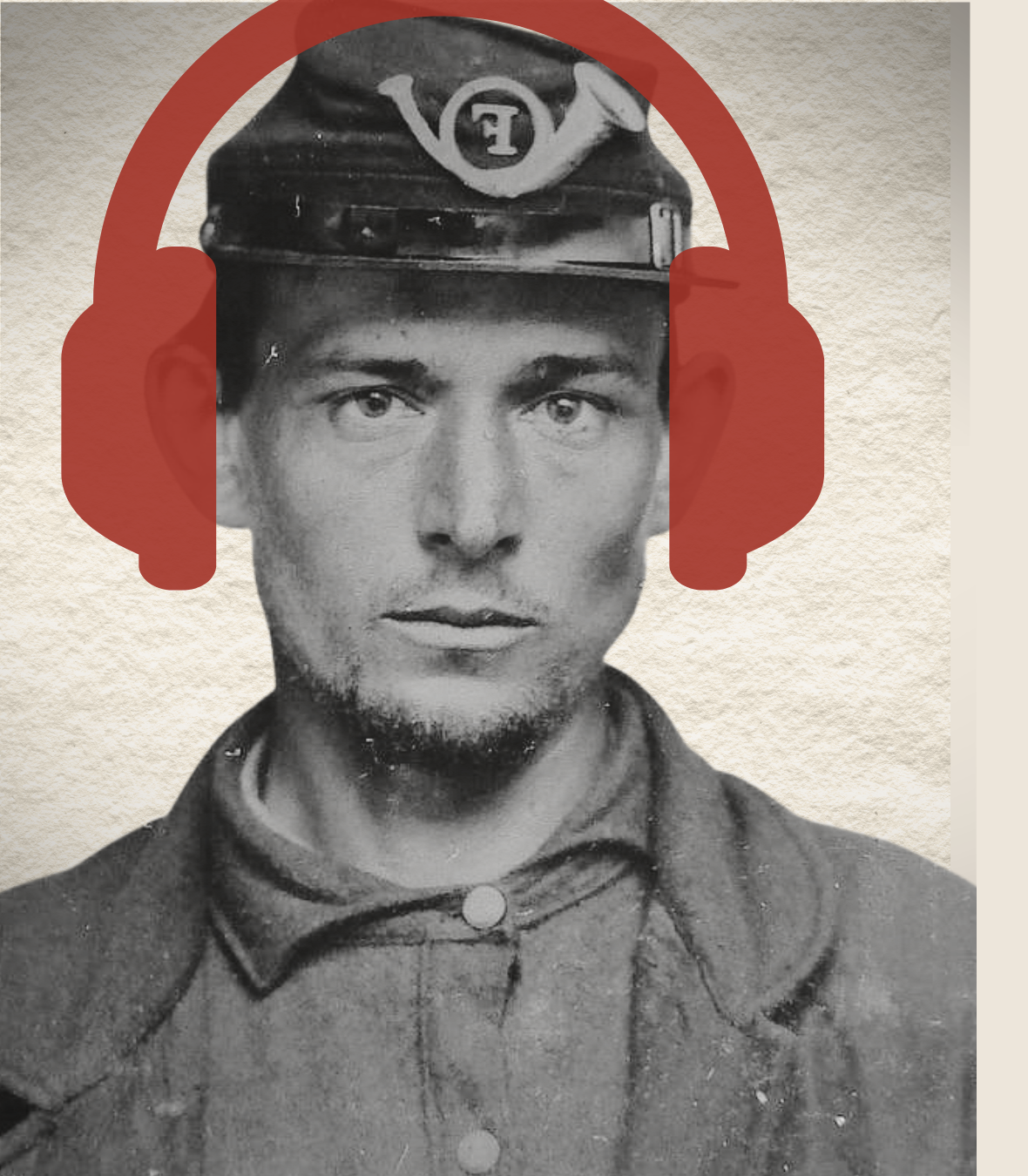
Moses O. Crafts: The Broken Soldier
Sometimes War follows you home
Season Two of Company D is sponsored in part by:


Ep13: Moses O. Crafts
Show Transcript
February 1862.
Moses Orville Crafts returned from the war less than six months after it began. He came home with a limp, wounded in the first great battle. A musket ball had ripped through his right knee at Bull Run.
He was discharged for disability, his service cut short.
While the discharge was honorable, the demotion was not. He had enlisted as a sergeant and left as a private. An administrative downgrade, but one that stung all the same.
Even with his knee aching constantly, Moses went back to work as a ship carpenter. On the walks down to the riverfront, he often needed a cane. When winter settled in, with harsh winds off the Kennebec River, and snow and sleet underfoot, the pain settled in his knee and stayed.
His life was already hard, but then it got worse. His wife, Rachel, was ill. They had been married for thirteen years and had five young children. Their oldest daughter tried to help, but she was only 11.
Rachel didn’t recover. She died on February 1, 1862. She was 43.
They barely had time to grieve when sickness struck again. A fever swept through the house that summer. His eight-year-old son, Orville, was the first to die. Two weeks later, his daughter Annie followed.
When the fever finally passed, Moses was left a widower with three children.
The war still raged on. His family had been cut in half. And he couldn’t walk without pain. All he could do was hope the worst was over.
INTRODUCTION
Hello, and welcome to another episode of Company D, the narrative history podcast about the men who served with Company D of the Third Maine Infantry Regiment.
This is the history podcast about real people, their lives and loves, their families and friends. We’re uncovering these stories so they won’t be forgotten.
Why Company D? Because this is personal. My great-great-grandfather fought alongside these men as a corporal in Company D. Charles F. Snell, 18 years old when he volunteered, kept a diary of his experiences in the American Civil War. That diary is the inspiration for this podcast.
I’m your host, George F. Snell III. Why three? Because three is a magic number.
In today’s episode, we meet Sergeant Moses Orville Crafts.
He was 40 years old when the Civil War started, among the first volunteers in Company D, and a man who helped recruit most of the other volunteers into its ranks in the spring of 1861.
Moses was a shipwright, a skilled carpenter with a growing family. He was also a committed Republican. He was an early supporter of the party and cast his presidential vote for John C. Frémont in 1856, one of only eight men in Bath to do so.
When Moses marched off to war, three of his brothers went too. He probably thought he was heading toward glory. Like most of the volunteers, he likely believed the war would end quickly, that their cause would succeed, and victory would be theirs.
He was right that the war would be over quickly. But only for him.
Moses was one of the first men in Company D wounded in battle after a Confederate musket ball pierced his right knee. The wound ended his war. And it changed everything that came after.
In this episode, we’ll follow Moses as he tries to hold together his health, his livelihood, and his family.
And we’ll return to the Battle of Bull Run, the first major battle of the American Civil War, and the first combat experience for the soldiers of Company D. Civil War nurse Clara Barton would later describe Bull Run as “the valley of death.”
There would be bloodier and deadlier conflicts in the Civil War, but Bull Run shattered the North’s illusion of a quick and easy victory.
And it shattered Moses Crafts’ knee.

CHAPTER ONE: FROM HEBRON TO BATH
Moses Orville Crafts was born on June 28, 1820, in the quiet hill town of Hebron, Maine. A rural community in Oxford County, Hebron was home to Hebron Academy, Marshall Pond, and wide stretches of farmland. When Moses was born, the town had a population of 1,700 people.
Hebron had been settled by Massachusetts veterans of the Revolutionary War and the War of 1812, many from North Bridgewater (now Brockton, Massachusetts), who were granted land in Maine for their service. Among these pioneers were Moses’s grandparents.
His grandfather, Samuel Crafts, was a captain during the War of 1812. He moved to Hebron with his wife, Ann Packard, and six of his children, including Moses’s father. Known for his powerful physique and restless energy, Samuel Crafts became a prominent figure in town. He was a founder of the Congregational Church and sent many of his children to Hebron Academy.
Moses’s father, also named Moses, and his wife, Sarah Sturtevant, were farmers. Their son, Moses, was the third of nine children. Moses’s father may also have been a part-time instructor at Hebron Academy, where Moses and his siblings learned to read and write.
It was a large, busy household with eight boys and one girl. But it was not untouched by loss. Two of Moses’s younger brothers died in childhood, one at two years, and the other at four. It was an early tragedy that would echo later in Moses’s own life.
Despite his family’s prominence in Hebron, farm life didn’t appeal to Moses. In his early twenties, he left for Bath with his younger brother, Justin, to learn the carpenter’s trade.
The city of Bath was booming. Shipyards lined the Kennebec River, and skilled labor was in high demand. The brothers found work and likely boarded in one of the crowded rooming houses near the waterfront.
On December 1, 1849, Moses married Rachel L. Curtis. They were both older than was typical at the time: Moses, 29, and his new wife, 30. The wedding may have been rushed, as Rachel gave birth to their first child, Stratira, seven months later.
Stratira was an unusual name, drawn from classical Greek mythology—perhaps a sign of the hopes Moses and Rachel had for their daughter.
Rachel had been born in Bath, the daughter of Freeman and Phoebe Curtis, but by the time of her marriage, she was living on her own. Both of her parents had died.
After their wedding, Moses and Rachel moved into a house owned by 76-year-old John Ripley and his daughter. Living under the same roof were the Ripleys, Moses and Rachel, Moses’s brother Justin, and members of the Mars family, a group of siblings who had lost both parents and were led by their eldest brother.
The Mars family may have been related to Rachel, possibly as cousins, but the record is unclear. However, what is clear is that the two families became closely connected.
By 1860, Moses and Rachel were established in Bath with five children. Their household included 17-year-old Julia Mars, who was attending school, and a young domestic worker, Almena Allen, who worked for the family.
Moses was doing well. He had likely risen to a supervisory role at Stephen Larrabee’s shipyard on Front Street. He was a skilled carpenter, a steady provider, and a respected member of the community.
It was the most stable period of his life. Then the war came and ruined everything.

CHAPTER TWO: BATTLE CRY FREEDOM
Moses was one of the original five sergeants of Company D. He served alongside:
- Alfred S. Merrill, who would later become the company’s third captain
- William H. Higgins, the bombastic future lieutenant known as the Old Warhorse of Phippsburg
- Benjamin F. Stimpson, who, like Moses, would be reduced in rank and discharged
- Otis W. Williams, who would meet the same fate.
These were not young men. Merrill was 35, and Stimpson was 36. The others were over 40. Within a year most of them would be gone, broken by wounds, illness, or exhaustion.
Moses would be the first to go.
After the Southern states seceded and Fort Sumter fell, President Lincoln called for volunteers. A loyal Republican and raised in a family that took pride in military service, Moses didn’t hesitate.
Like many men in Bath, Moses already had a taste of soldiering. He was likely a member of the Bath City Grays, a local militia company known for ceremony more than combat. They drilled with muskets and had been called out for service for a few emergencies, but mostly they were seen marching in Fourth of July parades, attending civic celebrations, and hosting elaborate charity balls.
In 1853, the Bath Grays even traveled to Boston to take part in the opening of the city’s new waterworks.
The Bath Grays were formed in 1850, and by the start of the war, hundreds of men had passed through their ranks. When the Third Maine Infantry was organized, its leadership in Companies A and D drew heavily upon the Bath Grays. They were respected and established community leaders.
But they were not professional soldiers.
When Moses enlisted on April 24, 1861, he was appointed Third Sergeant of Company D, a rank that spoke volumes about his standing in Bath. He stood five feet eight and a half inches tall, with a dark complexion, dark hair, and black eyes.
Moses wasn’t the only one of his family to enlist. He was joined by his two youngest brothers, Benjamin and Francis.
His other brothers, including Justin, sat out the war. Most of them were too old.
But Moses and his two youngest brothers volunteered. Both Benjamin and Francis went on to have the military careers Moses probably wished for when he enlisted.
But it was not to be.

CHAPTER THREE: TO ARMS, BROTHERS
Moses was 13 when his brother Benjamin Franklin was born, and 15 when Francis Marion followed. By the time they were grown, Moses had already left for Bath.
It’s not clear how close the three brothers were when the war started.
Benjamin was the scholar in the family. Born in Monson, Maine, on June 18, 1833, he was educated at Hebron Academy and later studied medicine at Bowdoin College. He left before graduating, but not before petitioning the Maine Legislature to change his surname in order to found a new family.
His petition was granted, and his last name became “Clayton.” Benjamin Franklin Clayton.
When the war began, Benjamin was living in New York. He volunteered with Company F of the 102nd New York Infantry Regiment and was appointed captain.
In December of 1861, the newly minted captain rented a storefront in Rochester, New York, and began aggressively recruiting men for the new regiment. He made it clear that old men and boys should stay away. He was interested only in first-class, able-bodied soldiers. Benjamin promised them the best rifles and even better equipment.
Six months later, he was leading them in battle. At Cedar Mountain on August 9, 1862, fewer than 8,000 U.S. Army troops met nearly twice that number of Confederates under Stonewall Jackson. The 102nd New York was devastated, with nearly half the regiment killed, wounded, or missing.
Benjamin was among the wounded. A bullet through the left lung. He shouldn’t have survived, but somehow he pulled through. He was promoted to brevet major and called a hero. He would distinguish himself at Chancellorsville and spend months at Libby Prison in Richmond.
He was promoted again to brevet lieutenant colonel. But his health suffered, and he was transferred to the Veterans Reserve Corps in 1863, ending his active service. He remained in the U.S. Army until 1869 and retired as a brevet colonel.
One of the men Benjamin recruited for the 102nd New York was his younger brother, Francis Marion. Francis followed a similar path, educated at Hebron Academy, then working as a merchant in New York before enlisting in the 102nd as a private.
His rise was as dramatic as his brother’s. He distinguished himself in combat. At Gettysburg, he helped hold the line with a force of 150 men under heavy assault, suffering more than 70% casualties. His bravery was rewarded with a promotion to brevet colonel.
In Crafts family lore, Francis became something of a legend—a soldier who seemed untouchable in battle. It was said that bullets tore through his clothing. One even passed through his hair. But he was never wounded.
He left the service in July of 1864.
After the war, both brothers stayed in New York. Benjamin became a magazine editor and later a vineyard owner in Florida. Francis entered public service as a Republican and worked as an agent for the Internal Revenue Service.
The war opened doors for them. When Moses volunteered, he may have imagined something similar for himself.
After he was wounded and sent home, he must have been proud of his younger brothers, but hearing about their daring exploits and their successful military careers must have stung, especially when the wound in his knee was flaring up.
And while his youngest brother’s legend of being impervious to gunfire grew in family circles, there must have been some resentment in Moses about it. How could there not be? Because a Rebel musket ball with his name on it changed his life forever.

CHAPTER FOUR: ON TO RICHMOND
In the weeks leading up to the Battle of Bull Run, Washington, D.C., buzzed with excitement. The U.S. Army finally moved out, leaving Washington to face the Confederates in what many believed would be a decisive, possibly final, engagement.
A loss seemed inconceivable.
When the Third Maine broke camp, they gave three cheers and marched down Pennsylvania Avenue singing “Dixie.” One soldier later remembered they sang it “in fine style.”
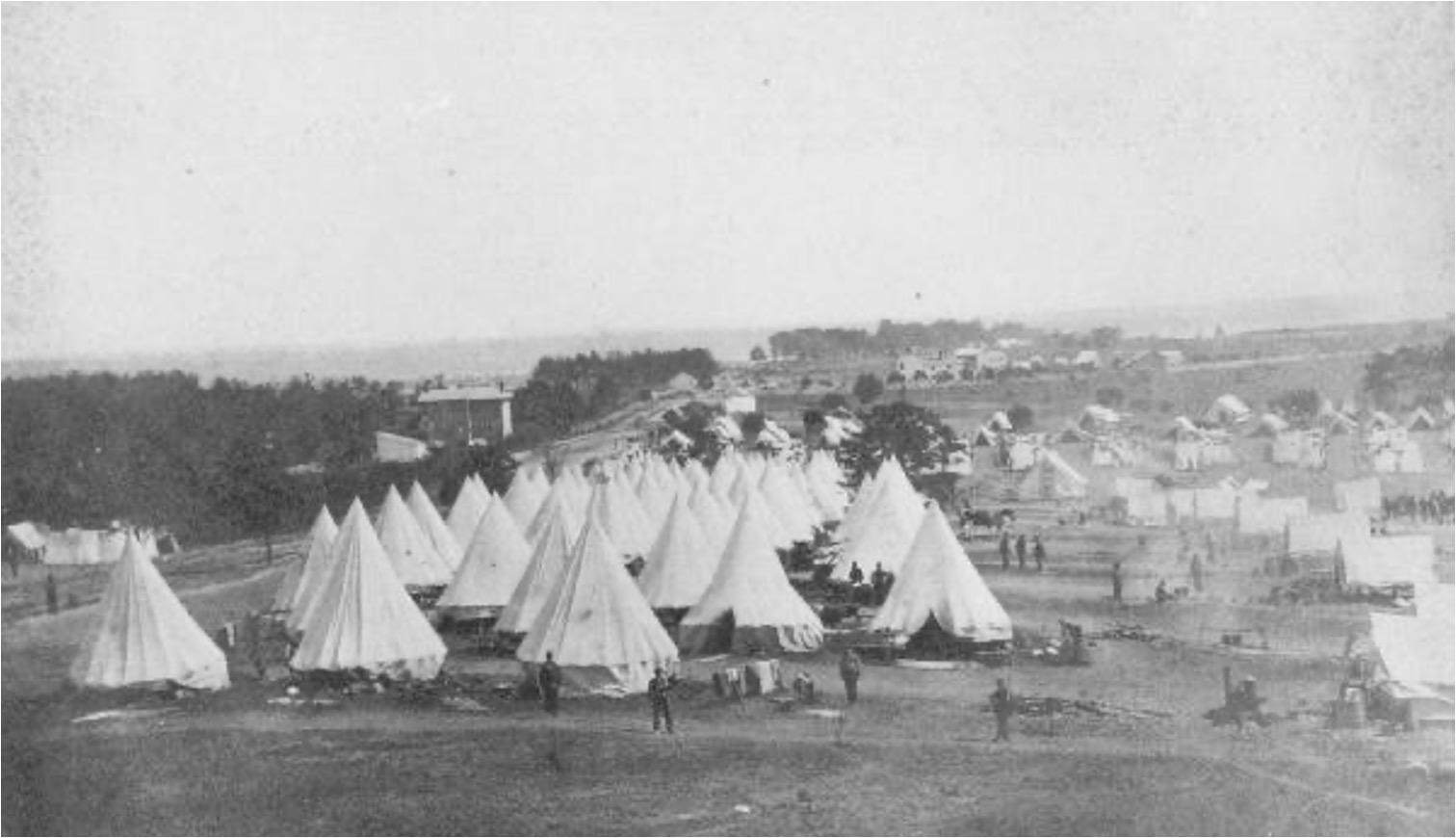
The regiment boarded the steamship Philadelphia and sailed to Alexandria, Virginia. From there, they moved into a new camp about two miles outside the city known as the Happy Valley. Within days, rumors of a Confederate attack spread through the ranks. Rebel forces were gathering just a few miles away.
They spent their days drilling and scouting. They also received new uniforms. Until now, many New England troops had worn gray. Now they were issued regulation Union blue; that one Third Maine soldier noted, “wears better and looks better.”
In the days before the battle, skirmishes broke out. Company D captured several Confederate soldiers, some of whom were sick with smallpox. Victory seemed even more assured to the men.
Then came Sunday, July 21.
The Third Maine was roused after midnight. By 3 a.m., they had joined a slow-moving column of Union soldiers six miles long, moving toward Manassas Junction. The Third Maine advanced a few miles before halting near Bull Run. Their brigade, the Third Brigade, was held back as part of the rear guard.
Soon, they could hear the distant booms of artillery. They waited. And waited. The hours ticked by.
Then orders came swiftly: advance to the battlefield. The men stepped off at double time, singing “John Brown’s Body” as they ran. The singing didn’t last long under the smoldering July heat. They ran for more than six miles.
Private Homer Bean later recalled, “We were driven with such haste that a good many had to give out and fall back… we were beaten out by running until we reached the battlefield.”
Soldiers collapsed on the way. Others shed their rucksacks and frock coats. Anything to lighten the load.
In a letter home after the battle, Private Albert Harriman complained about the pace. “It was warm. We could get nothing but muddy water to drink, and sometimes none at all, and about one-third of our men dropped down beside the road exhausted.”
When the Third Brigade arrived, they passed streams of U.S. soldiers, many of them wounded, exhausted, and defeated. Ambulances rolled by packed with wounded soldiers—men with broken bones, others with bloody bandages. Still others hobbled or limped along the road, using their muskets as crutches.
Soldiers from the Sixty-Ninth New York Regiment warned the Third Maine that the battle was already lost.
The Third Brigade pressed on. They reached the base of Henry House Hill and rested in a grove of trees. Artillery boomed. Chaos erupted around them.

CHAPTER FIVE: THE BATTLE OF BULL RUN
Sergeant Moses O. Crafts was among the members of the Third Maine who made it to the front line. He was winded, overheated, and thirsty, but he was still on his feet.
As the regiment caught its breath, orders came down. The Third Brigade was to support Battery One of the First U.S. Artillery, led by Captain James B. Ricketts, stationed on the top of Henry House Hill.
General Oliver O. Howard commanded the brigade. A West Point graduate and, until recently, the colonel of the Third Maine, Howard understood the situation almost immediately. The battery had already been overrun, but his orders stood.
Howard sent the Fourth Maine and the Second Vermont forward, out in the open and up the hill. Howard sat on his horse as the men surged by him. “I closely observed them,” he later recalled. “Most were pale and thoughtful. Many looked up into my face and smiled.”
The six cannons of Ricketts’ Battery were already lost. Captain Ricketts himself had been shot and captured. Howard’s men were exposed, and Confederate artillery turned its attention to them. Cannon fire and infantry musket fire from a wooded area to their right flank tore into them. “It made (for) rather warm work for the new men,” Howard noted dryly.
Howard then ordered the Third and Fifth Maine regiments up the hillside in support. However, the Fifth Maine had already fallen apart. Spooked by artillery fire striking their flank, most of the regiment was already in full retreat, leaving only a remnant to charge forward with the Third Maine. The Third Maine replaced the Vermont soldiers on the hilltop and, with what was left of the Fourth and Fifth Maine regiments, tried to hold the right side of the hill.
The situation was made worse because the Union soldiers couldn’t see the Rebels, who were hidden in the forest, and the ground around them was thickened by artillery and musket smoke. The air was heavy with musket shot and exploding ordnance.
“It was a hot place,” Oliver recalled later. “Every hostile battery shot produced confusion, and as a rule, our enemy could not be seen. Soon, breakages were beyond repair.”
Howard ordered the Vermonters to fall back into reserve, but his order was mistaken for a call for the whole brigade to retreat. The order broke down, and soon, men were fleeing down the hill.
Sergeant Lincoln Litchfield of Company A was blunt in his assessment: “The cannonading on our side had nearly ceased when we went onto the field; and why our brigade was pushed on for two miles at double quick to face grape and shell, without any artillery on our side, is more than I can say.”
Major Henry Staples, who was leading the Third Maine, said his men stood firm, exchanging more than twenty volleys with the enemy, before they, too, retreated down the hill.
It was here—bullets flying, the battlefield covered in black soot, and artillery bursting—where Moses Crafts was shot.
Moses was mid-stride, turning his body, exposing the inner part of his right leg, when he was struck. Confederate Minié balls were large .58-caliber bullets capable of causing devastating damage. This one hit Moses just above the right knee on the inside of his leg, traveled through his knee, and exited on the outside of his leg.
Moses’s leg would have buckled, and he would have fallen to the ground.
CHAPTER SIX: THE GREAT SKEDADDLE
Sergeant William H. Higgins later recalled being sprayed with the blood of the wounded during the battle. “Cannonball shells and minie bullets flew thick and fast,” Higgins wrote. “Several men were shot dead or wounded standing next to me, but I escaped without a scar; the blood of some of the men was sprinkled on my clothes.”
One of those men was 38-year-old Private Robert F. Sanborn Jr., a bachelor who lived in Bath with his widowed mother. Sanborn was a painter and fisherman who sent his military wages back to his mother.
Sanborn was the first soldier from Company D killed in combat and one of the five men from the Third Maine to die at Bull Run.
Another one of the wounded was Private Allan McKinnon, a Canadian-born fisherman who lived in Bath with his wife and children. The tall, blond-haired, and blue-eyed McKinnon enlisted in Company D at the age of 24. During the chaotic fallback from Henry House Hill, McKinnon tripped and fell.
“I was wounded in the Battle of Bull Run,” McKinnon recalled later in life. “That was a fight for you; dead men, dead horses, all around you. You could not walk without trampling on them. That is why I am a cripple now. I broke some ribs then, and they give me a good deal of trouble.”
Also injured was Private Andrew H. Stewart, an 18-year-old farmer from Bath, who enlisted in Company D with his father, Charles. During Bull Run, Stewart was hit by either a bullet or artillery shrapnel. He, too, fell and was eventually taken to one of the general hospitals in Washington, D.C.
As the line broke down and retreated, Moses was left on the hilltop, unable to walk. He spotted Company D’s Second Lieutenant Warren R. Matson through the wisps of black smoke and cried out to him for help. Matson, a 48-year-old ship’s carpenter, got Moses to his feet and had him hop onto his back so he could run him down the hill piggyback style.
Matson didn’t stop until they got to safety, despite wrenching his back so severely that he, too, would need to be hospitalized. The Third Maine fell back to the northwest toward Sudley Road and the Stone Bridge over Bull Run Creek. At this point, Moses’s rank as a sergeant likely got him onto the back of an ambulance, where he was taken to a field hospital.
The Battle of Bull Run ended in abject failure for the U.S. Army, with a surging, chaotic retreat known as “The Great Skedaddle.” The officers of the Third Brigade tried to frame their participation in the retreat differently.
Major Staples reported, “My regiment retired from the field over the plain, in full view of the enemy, in good order, but on reaching the woods became somewhat scattered. They soon rallied.”
And Howard delivered an understated, “There was very little organization before we reached Centerville.”
But the soldiers of the Third Maine didn’t pull any punches about the disaster of Bull Run. “We were whipped at Bulls Run,” Hannibal Johnson of Company B wrote to a family friend. “We were as a whole a very weak army, and if the enemy had kept up the pursuit, I have no doubt… they could have taken Washington.”
Sergeant Litchfield of Company A called the retreat, “a perfect panic.”
Private Charles Snell said a cannonball exploded three feet away from him as he ran off the hillside. The regiment ran through woods and fields, being ambushed by Confederates along the way before collapsing in exhaustion at Centerville. “The most sickening sight,” Snell said, “was to see them fetching the dead and wounded off the field.”
The Battle of Bull Run was over. A defeat for the United States Army, and a shattering introduction to war for the Third Maine.

CHAPTER SEVEN: NUMB, COLD, AND USELESS
The wound to Moses O. Crafts’ knee ended his military career.
He was first treated at a field hospital before being transferred to a general hospital, most likely in Washington, D.C. The medical diagrams in Moses’s pension files show his wound was “through and through,” with the bullet passing through his leg but not lodging inside.
Moses would have been treated by a surgeon, likely rendered unconscious with chloroform before the procedure. The surgeon would have inserted a metal probe into the bullet track to ensure no bullet fragments remained. Then, the surgeon would have enlarged the wound to remove dirt, clothing fibers, and bone fragments. The wound would have been packed with linen bandages, and his leg immobilized with wooden splints.
Moses was fortunate. Many surgeons had to amputate the legs of men with knee wounds because infections were very common. The fact that Moses kept his leg suggests that his kneecap had not been completely shattered and that no major arteries had been severed. The surgeon concluded that there was a possibility that Moses’s joint still worked.
While he was recovering in the hospital, Moses was demoted from sergeant to private—a routine administrative decision—so that Company D could promote another man to sergeant, knowing that Moses would never return to duty. The reduction in rank had nothing to do with Moses’s performance, but it still must have hurt.
He suffered another indignity when the Kennebec Journal reported two weeks later that Moses had been “slightly wounded,” a gross understatement for a wound that would leave him with a permanent limp and cause him pain and discomfort for the rest of his life.
Moses’s wound left him disabled, with one surgeon saying he was “three-fourths disabled from obtaining his subsistence from manual labor.” A devastating blow for a man who made his living as a carpenter. His injury would improve with age, but his knee would remain at half its strength and function.
The wound would also flare up, sometimes leaving him lame and other times causing abscesses—localized infections that would swell and fill with pus. This would present as swelling around his knee, severe pain, and occasional bursting or drainage. It’s nearly certain he needed a cane to move, and possibly crutches when the wound flared up.
In his later years, Moses described his right leg as cold, numb, and useless.
He was officially discharged from Company D and the Third Maine on September 18, 1861.

CHAPTER EIGHT: NO RECOVERY
Less than a year back from war, Moses dealt with his wife’s death, followed by the deaths of two of his children. He was left a widower with three daughters. Moses needed to marry again quickly to ensure his daughters’ well-being.
He found a second wife in 44-year-old widow Anne Reed Travers, who had two children of her own. Anne’s husband was a sailor who died of unknown causes before 1860. Moses and Anne were married on November 9, 1862, nine months after Moses’ first wife died. Almost certainly a marriage of convenience.
At the shipyard, Moses did his best with his injured knee. But it was an uphill battle. He applied for and received a monthly disability pension from the federal government in 1863. He collected this pension for nearly the rest of his life, and he never returned to the financial prosperity he had achieved before the war.
He transitioned from manual labor to training as a draftsman, drawing technical plans that carpenters used to build vessels. He became so skilled that he petitioned the Bath City Council to establish a school for mechanical and industrial drawing in 1871, but the proposal was rejected for lack of funding.
When the war ended, Moses became a founding member and the first chairman of Bath’s first veterans’ organization, a precursor to the Grand Army of the Republic, which was incorporated the following year.
His children began to build lives of their own. His oldest daughter, Statira, married a bookkeeper in 1867 when she was 16. The couple moved to Chelsea, Massachusetts, and later to Brooklyn, New York. They had six children together.
In 1880, his daughter Fannie, 24, married the son of a Vermont hotel keeper. Her husband was a veteran of the war, having served with Company D of the 1st Vermont Heavy Artillery Regiment. They lived in Chicago and had two sons together.
In the summer of 1880, at age 60, Moses lived at 134 Washington Street in Bath with his wife, Annie, 62, and his daughter, Flora, 20, a schoolteacher. Flora was listed as “living with consumption.” She suffered for three more years and died in 1883, at age 24.
After his daughter died, Moses moved to Auburn, Maine, 20 miles northwest of Bath, and became active in the local government. He remained firmly committed to Republican politics despite his injuries and losses.
CHAPTER NINE: THE FOREVER WAR WOUND
The wound to his knee worsened as he aged. In 1890, Moses still received a monthly disability pension of $6 from the federal government. He was examined by a doctor in Lewiston, Maine, that year at age 67.
Twenty-nine years after being shot at Bull Run, the doctor reported that Moses’s knee remained three-fourths disabled. He still experienced pain when walking or standing, and the scar tissue had adhered to the bones in his knee. He continued to limp, still using a cane. He also suffered from heart disease, compounding his condition.
In 1892, Moses became very ill and died a few days later after passing a gallstone that triggered a heart attack. His obituary was four paragraphs long in the local newspaper, noting his service and gunshot wound in Company D of the Third Maine, but the final paragraph focused on the exploits of his younger brothers, Benjamin and Francis, who saw “long and hard service in the late war.”
Moses never became as successful or as renowned as his two younger brothers. It’s true that Benjamin and Francis saw long, hard service in the Civil War, but neither endured the decades of suffering that followed Moses. Every time Moses walked or stood, pain flared through his knee. He carried the pain of the war with him everywhere he went.
Moses may have served less than three months in the U.S. Army, but few volunteers face longer or harder consequences than Moses O. Crafts.
Thank you for joining us for another episode of Company D. A special thanks to Evan Boyerman for providing us with artillery sound effects on FreeSound.
Company D is supported by our listeners. We want to take a moment to thank our Patrons, whose support has helped make this season possible. A special thanks goes out to: Pritesh Ghandi, Trapper Markelz, Jeff Parent, Alex Mueller, Michael Scelfo, Erik Snell, Andy Polansky, Mike McGrail, Scott O’Donnell, Lisa Furnald, Jay Hanley, Art Trapotsis, and Jeff Govoni.
You can find photographs, maps, and rare historical documents related to this episode on our website: companydpodcast.com. You can also find bonus material and other information about Company D on social media channels. If you have questions or comments about the show, you can reach us at companydpodcast@gmail.com.
Please subscribe to Company D on your favorite podcast app. Join us again soon for another episode of Company D.
I’m your host, George F. Snell III. See you next time. And remember—Sometimes the least suspecting among us make the greatest sacrifices.


Leave a Reply